Saturday, November 23, 2013

Desierto de la Tatacoa

To get from San Augustin to Villavieja I had to take a bus to Neiva and transfer. I was immediately assaulted by countless people trying to sell me a ticket to Bogota on theirparticular busline. One fellow followed me persistently, chattering away, even after I informed him I didn't speak Spanish. I finally told him loudly and firmly, "No hable!" which made all the other drivers laugh but turned him off once and for all. I finally found a little rattletrap minivan to Villavieja with a slightly sleazy driver and a group of teenage boys, one of who tried to offer me his manly services as if I wasn't old enough to be his grandmother. No, I was not impressed with Neiva.

Villavieja is a dusty little desert town of one story buildings, many with bands of color painted on the lower portion and sometimes around doors and windows. I think the little church on the square is the tallest building around. In that square is the strangest statue I've ever seen grace a square anywhere. Yet, this was a very friendly little town and it comes to life in the evening. A woman selling the best empanadas for only 500 pesos from a little stand in her doorway broke into a huge smile when she saw coming for more.


This statue could be a cross between a bear and a dinosaur.

I found a little eating establishment, four stools big with a couple small tables out front and a sign that advertised 'jugos naturales' in several flavors. In my very basic Spanish, we discussed which ones might be good mixed with milk and I opted for one with a fruit I didn't know. She proceeded to scrape the slimy insides out of a fruit with yellow, withered-looking skin, added it to the milk, then took a long form of ice out of the freezer, picked up a rounded rock and bashed pieces off it to go in the blender. I laughed aloud which led to an attempted discussion about the cleanliness of the rock, then a more successful one about our lives and children.

The people where I rented a room called a friend to be my driver and guide to Desierto de la Tatacoa, my objective. His name is Gustavo and he drove an old Renault that had a passenger door needing to be opened from the outside which he did in a very gentlemanly manner every time I wanted to get out for a photo. It also failed to restart a time or two until he would get out under the hood and pound the battery terminal with a rock. After that, it didn't want to go into first gear several times...and a good time was had by all.


Desierto d la Tatacoa is an unusual landscape for Columbia, a very green country. I understand that the mountains surrounding it take all the rain, leaving it a dry but sculpted landscape, as if a little piece of Utah was dropped into it settled in. The formations come in red and white, sandy, and graced with several different kinds of cactus. There are an a couple campgrounds, an observatory and a pool fed by a one of the few springs where people go for a dip. I think it is to have some sort of good luck cleansing quality but can't be positive due to the language barrier. A stairway of rubber auto tires leads down to it. Cattle also roam this desert, skinny ones with big, floppy ears, a hump and a long wattle under their necks.


It is hot, hot, hot in Villaviejo. I developed a serious headache and hopped a bus to cooler climates early the next morning.

Friday, November 22, 2013

San Augustin, Columbia

San Augustin is my favorite place in Columbia so far. It isn't that this town has a unique look about it because it doesn't. In town the buildings are one, maybe two story stories of the usual variety. There are panaderias, resturantes, stores that sell basic needs, always a market, a few artisan shops...it could be one of many small towns in Columbia. The difference is the people.
 
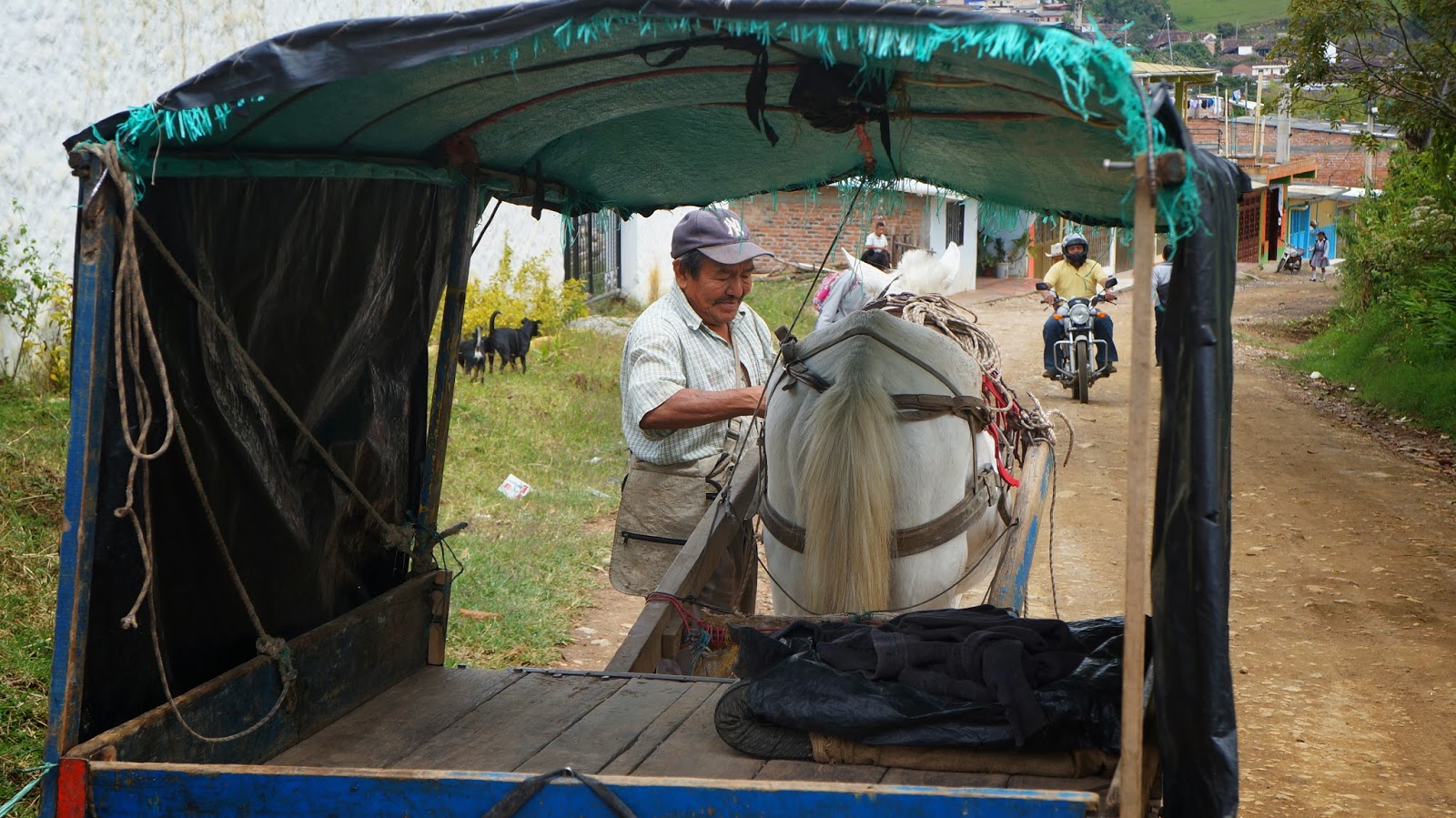
My hostel was on a dirt road outside of town, a road that is unpaved starting maybe a hundred feet from the square but we were not that close in. People walk and everyone greets with a "buenas dias" and a smile. Some rode into town in horse drawn carts, mostly single axle with auto tires. Outside the market, the horses stood patiently like so many diagonally parked cars while their masters sold their produce or shopped. Of course some people have cars but not as many in this end of town, and many a motorcycle whizzed by me.


 One woman told my friend Niko that up until two years ago San Augustin was full of guerilla fighters but it is safe now. It feels quite safe to me. A woman on the square was making a panela of fresh squeezed sugar cane rendered with gelatin from fresh hooves. She would scoop this mix from a pan beneath a post rigged on her cart. Then she would work it rather forcefully all around and it would get thick and stretchy almost like pulling taffy. When it got too thick she scooped more. She was in constant motion all day and was rewarded with many customers. It was much too sweet for my taste. Another woman I walked a distance with, told me how she had come from Germany with her children, found a nice house to rent, married and settled in. I could be tempted to settle there myself.
 
  
San Augustin has a big archaeological park with many burial sites and stone statues. They date starting around 800 AD. It was apparently the in place to be buried for a fairly long period of time. I couldn't find mention of a particular people, they are simply called indigenous people. There were a few mounds excavated in the park, a spring area with stones carved and laid out in some significant manner and a beautiful bamboo bridge. There was an overlook site that I thought was not worth the long, heart-thumping climb. Another area , Bosque de las Estatuas, is a trail with about thirty statues said to be recovered from grave robbers. Bogota decided they needed a large number for a permanent exposition. The townspeople were outraged and blocked off the road to the park. Now, along the trail, there are several flat replicas made of something like foam-core with signs under them explaining that they are in a Bogota exhibit. I noticed the noun 'to be' is the temporary state and hope that is the sign of a small victory.


A cutout of a missing statue.
 
I have to confess that I am totally enamored with some of the plant life I found in the area. Bamboo grows to be easily five inches in diameter and is used in all kinds of construction projects.. The shoots can be taller than I am and still be called shoots while the adult plants tower overhead. Air plants root themselves in trees and something similar but smaller attaches to power lines in town. And the flowers, oh! the flowers....

A bamboo bridge at the park.


Thursday, November 21, 2013

Popayan, Columbia


I can't say that I was particularly enamored with Popayan. It is known as 'the white city' because it is just that, white. I am in love with color. This is a Colonial city with very plain architecture, red tiled roofing and paved streets. Some of the balconies are nice but, to me, just another city. It was much more fun under the streetlights with a good camera.


I wandered, peeked into churches and drew some pictures on the Parque Calore. In the afternoon, I hiked up the hill to an overlook with a hero-on-a-horse statue and ran into Niko taking photos. Perched on the statue was a beautiful bright yellow bird. I saw a huge black bird in a tree near the university and an unusual black-white-brown one on the path to the statue. Otherwise, there are plenty of pigeons perched on the church in the square. I am not seeing the bird-life that I expected in this country.

There was a demonstration in the square, a very short march with two banners carried by a small crowd of enthusiastic college-aged participants and, against the wall, a long row of police with riot shields. It happened, few paid attention, and it ended and was immediately forgotten.


The most exciting part of my Popayan visit was leaving it. Our short bus careened along high ridge roads, through beautiful spring-green grasslands where I saw a couple long-drop waterfalls. Next was a high rain forest, not an incredibly tall canopy full of chattering monkeys, but a lower, dense growth of plants that you don't see every day. There were clusters of deep red trumpet flowers, large, bright yellow daisy-shaped flowered trees, huge dagger-type grasses, elephant ears, ferns, fern, and more ferns, huge ones. There are no people living here. When I looked out the other side of the bus it was all dense clouds. It’s a good thing because that sheer drop can be very scary at high speed on a rutted dirt road. Miles later, we dropped down into cropland of coffee and sugarcane. In a village alongside a river we were transferred to the back of a pickup truck filled with people, huge sacks of oranges and with a bunch of bananas tied on top. Onward to San Augustin.
Mountain bus stop on a drizzly day.
So close to the edge!
Another good traveling companion.


Tuesday, November 19, 2013

Sylvia, Columbia

By far the most exciting thing I´ve done in this country is to go to the Tuesday market in Sylvia. Once a week the Guambiano people come down from the villages surrounding Sylvia to sell their wares as well as stock up on others. The Guambiano, one of Columbia`s oldest indigenous peoples, still dress in their traditional costumes of a blue shawl, bowler hat and skirt, even the  men, though I notice many of the teenage boys are wearing pants. The women wear thick strands of some kind of bead around their necks, had net bags slung on their backs and carried beautifully patterned wool shoulder bags.

On the square in Sylvia


 The market itself is huge and very colorful. On the street there are many clothing booths but inside there is a riot of color where fruits and vegetables adorn table after table after table. Some areas have huge canvas sacks of different kinds of potatoes and rice; sugars come in different colored bricks. There were cooked items and I fell in love with some empanadas made of yellow corn with mashed potato inside.


On the meat section, fresh cuts hang in all shapes and sizes, horrible to those not used to gore, the cutters and attendants get a big kick out of leading us greenhorns through, pointing out hooves, hearts and eyeballs among other things.


My travel partner, Niko, found out about a small settlement higher up so we took a ride in a small Land Rover with eight people and two panes of glass in the back, two up front, two more on top and two men standing on the bumper. We were pretty packed in but having a really jolly time of it. Our destination was Casique, not a town with a square but a caseria, like a neighborhood almost at the top of the mountain. It is an agrarian community that grows potatoes, some corn, and lots of poppies, all worked by hand. We stopped at the school where there food for lunches is grown on the grounds, all of it, even the meat. The gardener told us the students have the job of feeding the bunnies, chickens, pigs and sheep on his off days.
Too bad this bus is full.

View from Casique

Casique - Looking the other direction.
In the late afternoon, we boarded another bus for another ride along a twisting, winding, ridge hugging road with yet another madman at the wheel. As usual we arrived alive in Popayan. Whew!


Wednesday, November 13, 2013

Villa de Leyva, Columbia

Villa de Leyva is a very small town a few hours north of Bogota. It has a very white washed look with red tile roofing, balconies and overhangs framed in dark wood. Colonial, they call it. The churches are not ornate, not even inside, and they tend to be that square steeple Spanish style, hardly exciting after the cathedrals of Europe. Nonetheless, this is a charming little town, especially when the clouds start to pile up and the afternoon sun bathes everything in golden light. There are a couple major roads that are paved but many are of cobblestone, large, uneven and a challenge to negotiate. What fascinates me is that there are very visible fossils in a number of those stones and potsherds of indeterminate origin scattered among them.


Saturday Market
Check out the feathered pets
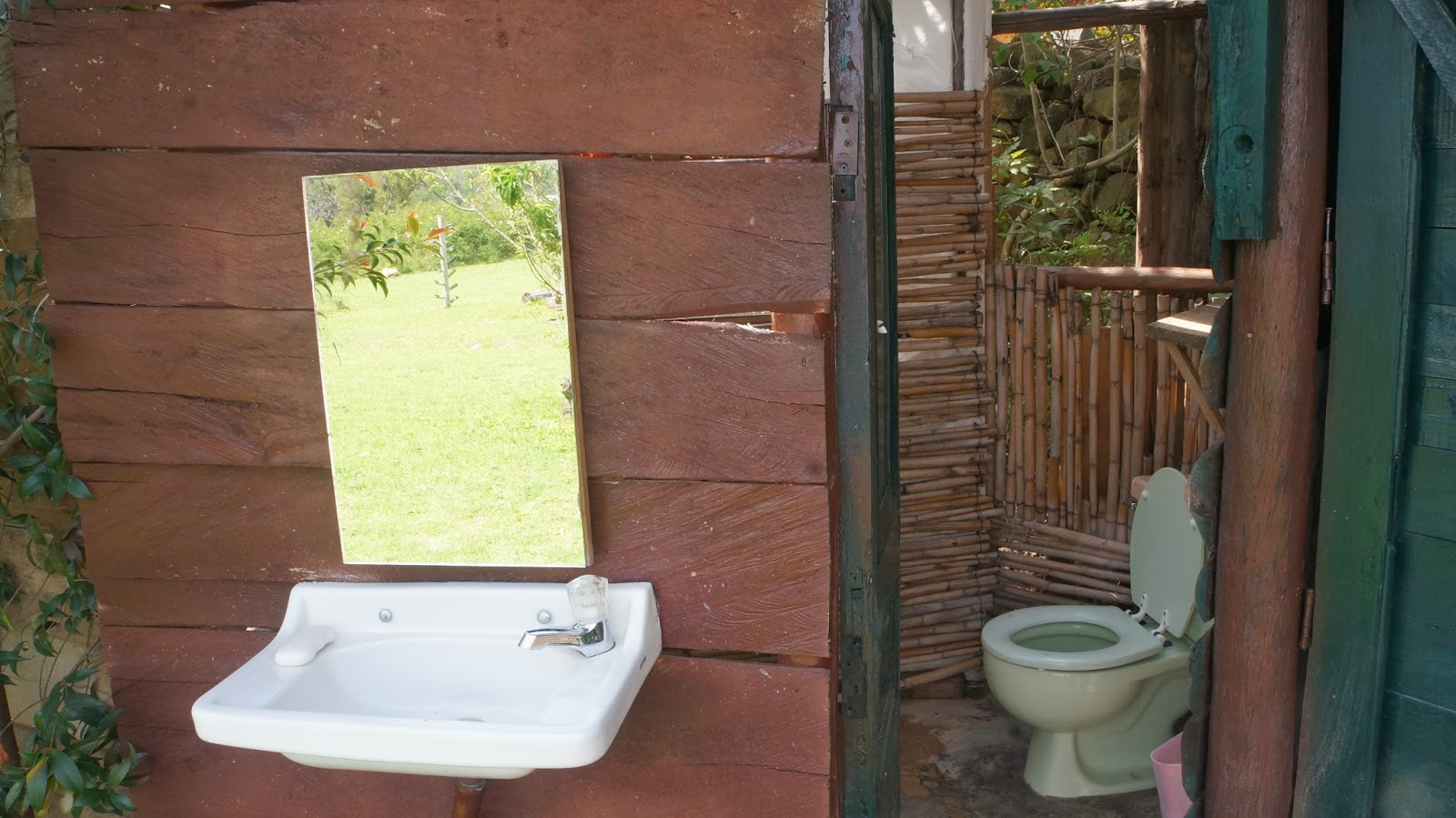
My hostel was the funkiest yet most unique I’ve ever inhabited. It shows its age and I certainly don t object to that. The owner, a woman who greets everyone with great affection, has it decorated in the most interesting art I’ve seen, from pencil drawings to posters, to odd things such as antique steam irons, along with the cable spool chair, vapors couch and the antique chair with the peg leg. The roof overhang is extended with plastic that leaks badly in a hard rain. Three makeshift bathrooms, toilet only, are sort of roughed in with rounded slabs from a lumber yard and bamboo. There is one sink on the wall outside and one room is opened up daily for all to share the shower. This place is so eclectic I couldn’t help but fall in love, especially with the large green yard that unfortunately filled with campers on the weekend. The owner offered to move my friend and I to a room in her brand new hotel but we both couldn’t bring ourselves to leave.


One must get away from the square to eat like a local so for every meal we take a different route and choose a hole in the wall to dine in. I’ve had three different kinds of cream soup, chicken, beef and catfish. They all are thick with a base that is distinctly bean, each a meal in itself. One night I had arepes, a thick tortilla with choriso sausage for Dave and for me, mushrooms, beef and cheese. The locals snickered a little because it is to be eaten by lifting the little plate, sliding it just enough off to chew on but I tried to eat it like a well-buttered pizza. I am particularly fond of the drinks, especially lulo juice, as well as those I can’t pronounce.

The side trip was to El Fosil not too far out of Villa de Leyva. Their major attraction is a Pliosaurus from the Cretaceous Period. It is displayed in a bed of sand, an organized skeleton of fossilized bones, much the way it was excavated. They also had many ammonites, those coil looking fossils, concretions split to reveal fern fossils, petrified wood and quartz crystals. I had a little side trip of my own taking a short hike up the road, checking out the ditch. It was quite the little geology adventure that ended with a cone of raisin ice cream back at the museum.

My last day I spotted this old homestead behind the bus station


Tuesday, November 12, 2013

The Road to Villa de Leyva

I took one of many minibuses leaving from the Bogota terminal to Villa de Leyva. It was not an express bus, stopping for just about anybody who wanted to ride it, or so it seemed.

My seatmate

 Finally, out of the city I got my first glimpse of rural Columbia. I was taken by the many shades of green as fields checkered through valleys, up and over hills, some fairly steep.  Small villages lined the roads, mostly white houses with gently sloping rooflines covered in red tile or corrugated fiberglass and a cow was tethered here, another there, along the highway. As the mountains got steeper and rockier, there was more cultivation, mostly potatoes. I love the look of those heavily furrowed fields, many being harvested with huge pink plastic bags full of spuds dotting the rows. I saw one fellow leading two horses with sacks of potatoes slung over their backs but mostly there were trucks with rounded forms over the back covered with black shiny tarp material, looking like dark, rolling greenhouses.


In Tunja, the bus was turned back due to road construction. We were led by a motorcycle cop over what was barely more than a one lane dirt track that wound for an extra hour´s worth of slow, creeping miles along the edge of the mountains. It was steep, very rocky, rutted and quite a different challenge for a driver who was accustomed to cornering at top speed as though he had foot pegs to scrape. Our brakes were screaming and everyone looked really tense. I was the only one that seemed to enjoy the adventure, looking out at plants and trees I´ve never seen before, beautiful green valleys and spring-fed lush little homesteads.


I can´t count the times I had to keep myself from shouting out ´stop the bus!´ so I could take a photo. Shooting pictures through dusty windows of a moving, lurching vehicle is a challenge and I had little success.

Monday, November 11, 2013

Bogota, Columbia


I arrived in Bogota late at night and took a prearranged airport transfer, the safest route to the hostel I booked in the Candelaria district, the old part of town. All the guidebooks warn that this area is not safe at night and I believe it. At midnight we arrived passing several little clusters of men hanging out on the street. I noticed when we got out of the cab that they moved in on us just a little but did not bother us. We had to hike up a very narrow cobbled alley to get to the hostel itself. 

One of my planned destinations was the Museum of all thing fat featuring the Colombian artist Fernando Botero. In it were many of his paintings, big ones of big people, big fruits, even portraits of other artists, all blown up and fat. What a sense of humor! His later style was wonderful, having the look of soft, blended pastels though much of it was done in oil. He also sculpted beautifully. There were paintings by on the notable artists but his were the best.


In a large square in front of a huge old cathedral, there were a handful of people gathered with llamas selling yellow tubes of something I did not buy or even inquire about. Other than them, the square was carpeted with pigeons, millions of them, I´m sure. After watching for a while I figured out what was in those tubes...food for the pigeons. People buy it, pay for the privilege of being covered with wildly flapping, pecking birds for a few minutes. What fun to watch them.

I stopped to eat in a tiny cafe because I was attracted to the little mounds lined up in the window, colorful and obviously sweet. I wanted substance so I went in and ordered a large item wrapped in leaf, a tamal, and a glass of curuba, a fruit found only in the high altitudes of Columbia, mixed with milk. The tamal made with a more textured masa than those from Mexico made of corn with yellow peas in it that looked like mini garbanzos. Inside that was a very tender chicken drumstick, bone and all. Delicious. I even tasted the leaf because  it looked so much like a seaweed but was not at all salty. I asked the owner who was a tall distinguished man, seventh generation of this family-owned business in a 400 year old building. He told me the leaf was a plantain variety. 

What impresses me most about Bogota is the graffiti  It is everywhere one can possibly paint, miles and miles along the highways, on just about every wall, on buildings. No surface is safe from it. It ranges from colorful scribbles to fantastic fine rt. On a bus I passed through an area of new brick apartment buildings, block after block of them, all with iron fences. No graffiti (yawn) how dull. If I were a graffiti artist, I would take that as a challenge.